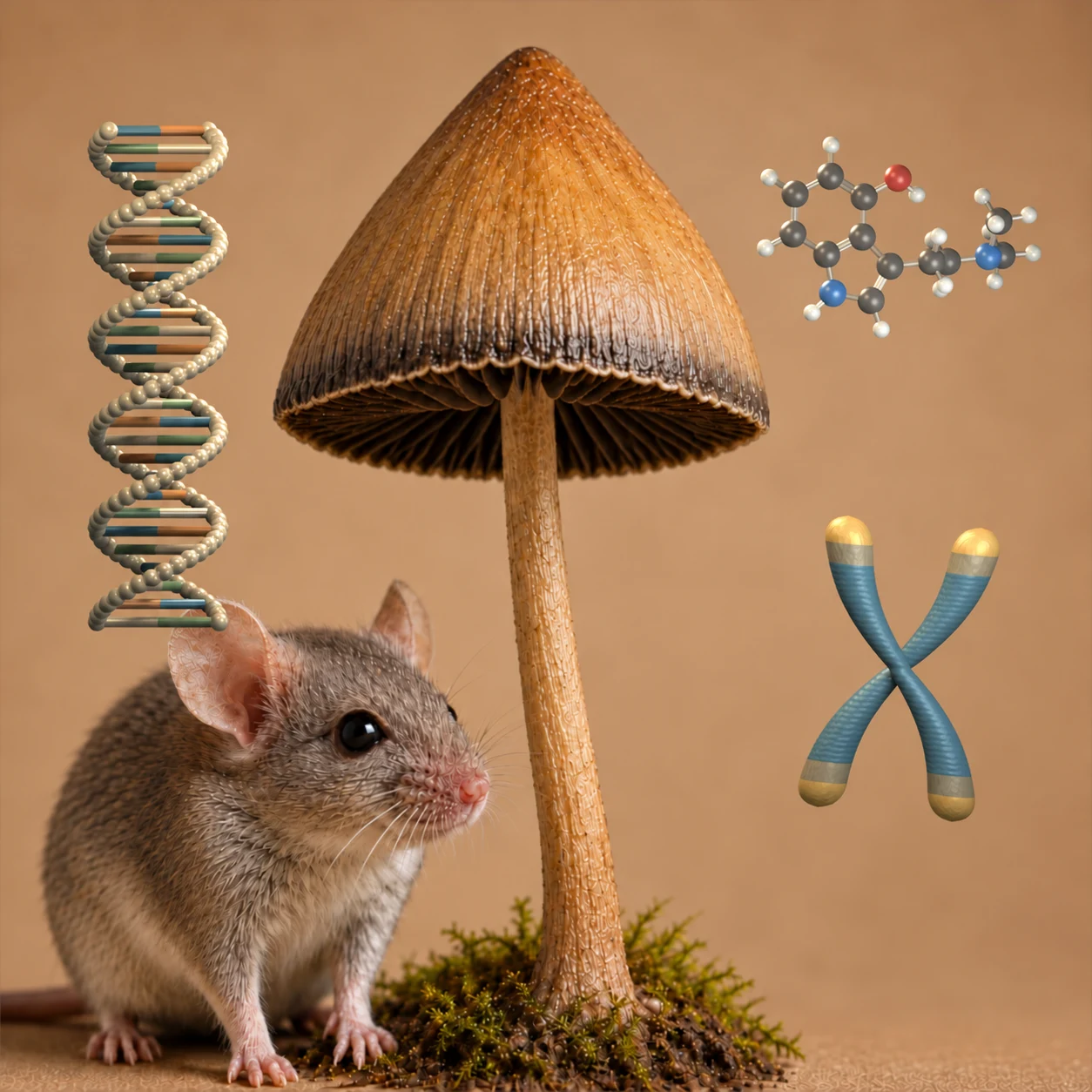
Psilocybin and cellular ageing
DeepDive PodcastEpisode #2
Playlist2/2
Transcript following paused
The conversation discusses preclinical findings in cells and mice and their limitations. It does not establish a lifespan-extending effect in humans.
Full transcript
Welcome to The Deep Dive, the show where we try to unpack some complex science and make it really accessible. Today's Deep Dive is proudly supported by RevGenetics, and we're jumping into something, well, pretty surprising today, a study that looks at psilocybin. Yeah, that's psilocybin, but maybe not in the way you're thinking. It's about its potential to actually extend cellular lifespan, even improve survival in older mice.
Yeah, it's fascinating stuff. This was published with the Japanese Society of Anti -Aging Medicine.
Right, so we're moving beyond the usual talk about its effects on the brain and into, well, longevity itself. Let's get into it.
Okay, so, you know, most people hear psilocybin and they immediately think mental health, right? Depression, anxiety, addiction, maybe even Alzheimer's research.
Absolutely. And there's solid clinical evidence for that potential. It seems really powerful for some people.
Definitely. The effects can be profound, sometimes even from like a single dose, but the how, the actual molecular nuts and bolts behind those benefits, especially outside the brain, has been a bit of a black box.
Right. Most studies just focus on the neurological side.
So this new study kind of steps back and asks a, well, a much wider question. They introduced this idea called the psilocybin telomere hypothesis.
Telomeres. Okay, those are the protective caps on the ends of our chromosomes, right? They shorten a cell's age.
Precisely. Think of them like the little plastic ticks on shoelaces. They protect the important stuff, your DNA. Every time a cell divides, they get a bit shorter. Eventually, they get too short and the cell stops dividing. It goes into senescence. That's, you know, a key part of aging at the cellular level.
Okay, I follow that. psilocybin, how does that connect to telomeres? That seems like a big leap.
It does, but here's the link they explored. We know our mental state can influence telomere length. Things like chronic stress, anxiety, depression, they're associated with faster telomere shortening.
Okay, so bad mental states, faster aging at the cellular level.
Kind of, yeah. And conversely, positive mental states seem to correlate with longer telomeres. So the researchers thought, well, psilocybin seems pretty good at improving those negative states. Right.
Could it directly impact the telomeres themselves? Could it actually influence biological aging through that pathway? Nobody had really tested that before.
Okay, so from mood improvement to actually changing the aging clock in our cells, that's ambitious. How did they even start to test that?
They started small in the lab with in vitro studies using human cells. And they used psilocin, actually.
Psilocin.
Yeah, that's the active form. It's what psilocybin breaks down into in your body. It's the molecule that actually does the work.
Got it. So testing the active compound, what happened in those human cells?
The results were pretty striking. They used standard cell types for aging research, human fetal lung fibroblasts, and also adult human skin fibroblasts. And psilocin treatment significantly extended the lifespan of these cells.
Extended lifespan. Like, they just kept dividing longer.
Exactly. They just kept going for much longer than the untreated cells.
How much longer are we talking? Like, a little bit, or?
Well, in the lung cells, a 10 micromolar dose pushed the lifespan out by 29 percent. But at 100 micromolars, it was a 57 percent extension. 57 percent in human cells.
Yeah. And even in the adult skin cells, the 100 micromolar dose gave a 51 percent boost.
Okay, hold on. 57 percent longer lifespan for cells in a dish. That's huge, isn't it? What was happening inside the cells?
They saw a whole shift. Psilocin basically delayed the cells from hitting that wall, you know, replicative senescence. They divided more times overall. That's the cumulative population doublings. And they divided faster, or rather, the time it took them to double decreased.
So, healthier, more active cells for longer. Not just surviving, but thriving.
That's a good way to put it. And when they looked at the molecular markers, it backed this up.
Okay, what did they see there?
They saw less of the stuff you associate with aging cells, like lower beta -galactosidase activity. That's a common aging marker. And lower levels of proteins that stop cell division, like P21 and P16.
So, less stop signals.
Right. And at the same time, more go signals, more markers of proliferation, like PCNA. It really looked like the cells were, well, more youthful.
It sounds like it. Do they pinpoint any key regulators making this happen?
Yes, and this is a big one. They found elevated SIRT1.
SIRT1, that's one of those longevity -length proteins, right? Involved in stress response, metabolism.
Exactly. It's like a master regulator for cellular health and resilience. Seeing SIRT1 go up is a really important clue connecting psilocin to these anti -aging effects.
Okay, SIRT1 up. What about oxidative stress? That's always a big factor in aging.
They looked at that too. And they found significantly less oxidative stress. And it was dose -dependent, more psilocin, less stress.
How does that work?
It seems linked to lower levels of Nox4. That's an enzyme that generates damaging oxidants and higher levels of Nrf2. Nrf2 is basically the master switch for the cell's antioxidant defenses.
So less damage being produced and better defenses against it? That would certainly help the cells stay younger.
You'd think so, yeah. Less DNA damage, better overall protection.
Okay, so SIRT1, oxidative stress. But what about the original idea, the telomeres? Did they actually measure them?
They did, and this was crucial. They compared psilocin -treated cells with untreated cells of the same age that had become senescent. And the telomeres in the treated cells were preserved. They were longer.
So actual physical evidence? It supports the hypothesis?
It's the first experimental evidence backing that psilocybin -telomere hypothesis, a direct link observed in the lab. Pretty significant.
Absolutely. So, okay, in a dish, longer cell life, preserved telomeres, less stress, more vitality markers. It's compelling. But the big question is always, does this translate to a whole animal, a living being?
Right, the essential next step. So they moved to in vivo studies using mice, aged female mice specifically. They were 19 months old.
Which is like, what, in human years? Middle -aged?
Older, roughly equivalent to maybe 60, 65 years old in human terms, so definitely getting up there.
And what do they do with these older mice?
They gave them psilocybin, once a month for 10 months.
Once a month, for almost a year of their remaining lifespan. Okay. What happened?
The survival results were, well, quite stark. The mice that got psilocybin had an 80 % survival rate over that period.
80%. And the control group, the ones that didn't get it?
Only 50 % survived.
Wow. 80 versus 50. That's a massive difference in survival.
It really is a very significant increase in lifespan for these aged mice.
Do they look any different? Could you see any outward signs?
Yes. They mentioned phenotypic improvements. Basically, the psilocybin mice looked healthier. Better fur quality, more hair growth, less white hair, visible signs that they were aging better.
So not just living longer, but potentially healthier while doing it. Looking younger, even.
Seems that way. It points towards a systemic effect, not just something hidden away inside the cells.
So how do we connect the dots here? The cell stuff, the telomeres, SIRT1, less stress, and then these mice living longer and looking better, what's the proposed mechanism?
The study suggests psilocybin is hitting signaling pathways tied directly to cellular aging. It's delaying that senescence, boosting lifespan. And they point towards the 5-HT2A receptor.
Okay, that's the main receptor psilocybin interacts with in the brain for its psychedelic effects, right?
It is. But here's the key. That receptor isn't only in the brain. It's found in lots of other cell types throughout the body.
Ah, okay.
And previous research has actually shown that activating this receptor can boost SIRT1 expression and antioxidant enzymes, which, you know, fits perfectly with what they saw here. Elevated SIRT1 and reduced oxidative stress.
So, the same receptor, but triggering these longevity pathways in other cells via SIRT1 and antioxidant responses.
That seems to be the leading idea. It's a really neat connection between the known neurological target and these newly discovered systemic aging effects.
It's amazing how these biological systems are intertwined. A compound known for one thing turns out to have these, well, deeper potential roles.
And you know, that's exactly the kind of thing that makes this field so exciting. It deepens our whole understanding. It's actually why the team at RevGenetics focuses on researching unique compounds like fisetin, tetrahydrocurcumin, and resveratrol. They've been doing that since 2007. It's exciting to see studies like this discovering more about how nature's medicine cabinet is just so vast. You know, so much potential for health and longevity still being uncovered.
It really is. And RevGenetics' commitment to science -backed health education fits right in with what we try to do here on the Deep Dive. It's about sharing that journey of discovery.
Okay, so stepping back. This is pretty groundbreaking, isn't it? You said it's the first experimental evidence showing psilocybin hitting multiple hallmarks of aging.
That's right. Delayed senescence, preserving telomeres, better DNA stability, less oxidative stress. It ticks a lot of boxes associated with aging.
So what could this mean down the line for, you know, aging research or even therapies?
Well, the implication is that psilocybin could potentially be what they call a disruptive pharmacotherapy.
eruptive meaning.
Meaning something new, potentially game-changing. A novel, geroprotective agent. Something that actively helps us age healthier. Or maybe even a therapy for specific age -related diseases. It opens up a whole new direction. And the fact that it worked, even when they started treating the mice late in life, that seems really significant for humans.
It really does. Because often you wonder if you need to start interventions super early. This suggests maybe not. Maybe there's benefit even later on.
And is it feasible for older adults?
Well, thinking about safety, there was that clinical trial where people up to 70 years old took psilocybin with no serious issues. And the FDA has given it that breakthrough therapy status, which suggests a decent safety profile. So yeah, it looks potentially feasible.
Okay, sounds incredibly promising. But you know, with exciting early findings, there are always caveats, right? Things we still need to figure out.
Oh, absolutely. The study authors are very clear about that. We need more research to figure out the best way to use it. What's the optimal dose? How often? When should treatment start? Would earlier be even better? Lots of practical questions remain.
Makes sense. What about differences between people? Or, well, sexes.
That's another key point. This mouse study only used females just to keep things simpler initially. But we definitely need studies looking at males too to see if the effects are the same or different. Biological sex can matter a lot in how therapies work.
Good point. Now, you mentioned delaying senescence. Does that raise any concerns, like, about cancer? Senescence is sometimes seen as a safety mechanism against uncontrolled cell growth.
That's a really important consideration. And the researchers highlight it. Their cell studies didn't show any signs of the cells turning cancerous, which is good.
Okay.
But they strongly emphasize the need for long -term studies in animals specifically looking at cancer risk. If you suppress a natural anti -cancer mechanism like senescence over the long term, you absolutely have to rigorously check if that has any unintended consequences regarding cancer. It's a critical safety check needed for sure.
Right. Thorough long -term safety assessment is key. What about the underlying science? Are all the molecular details worked out?
Not completely. We need more work to pin down exactly how it's all happening. Is it all through that 5 -HT2A receptor or are there other pathways involved? And what about epigenetics? Things like chromatin changes or DNA methylation, these can alter gene activity without changing the DNA code itself. They might play a role too. Still more digging to do there.
So lots of scientific questions still open. Yeah. And what about just doing the research? Are there hurdles there?
Unfortunately, yes. The paper mentions the ongoing challenges. Psilocybin is still a scheduleized substance in many places, which makes research complicated and expensive. And getting federal funding for this kind of work has been historically difficult. These are real -world barriers that can slow down progress.
Despite those hurdles though, the overall feeling seems pretty optimistic.
I'd say so. Very optimistic, but grounded. These are early results, yes, but they're incredibly exciting. They genuinely open up a whole new way of thinking about psilocybin and its potential impact, stretching way beyond the mind and into the fundamental processes of aging itself.
Okay, so let's try to wrap this up. Our deep dive today really uncovered something unexpected, didn't it? How psilocybin, this compound we mostly associate with mental effects, might actually hold some keys to making cells live longer and promoting overall longevity. It really challenges how we think about aging. And we want to thank RevGenetics again. Their support makes these kinds of explorations into cutting -edge science possible. They're really committed to sharing knowledge about natural compounds in health.
Absolutely. And if you want to learn more about their mission and the science they explore, you can visit RevGenetics.com.
So as we finish, it really makes you think, doesn't it? What other compounds are out there, maybe ones we've overlooked or just misunderstood, that might hold profound secrets for a longer, healthier life? Something to ponder. Join us next time for another deep dive into the fascinating world of science.
Read the other episode transcript · Scientific background and sources